
AI’s Next Bottleneck May Be Financing, Not Chips
Bottom lineReported megadebt discussions suggest AI expansion may depend increasingly on executable funding terms. Cash-flow timing, customer contracts and hardware economics will determine which projects move forward.

The ability to fund a computing project could become as important as the ability to source its hardware. Reports of enormous AI financing discussions raise a practical commercial question: which projects can secure capital on terms their future operating cash flows can support? The answer may shape deployment schedules, supplier orders and the competitive position of smaller providers.
The Wall Street Journal reports that Broadcom has been working to arrange more than US$50 billion in financing for the custom AI chip it is developing with OpenAI, citing people familiar with the discussions. Its report also identifies Oracle and SpaceX as seeking large financing arrangements for AI hardware. These are reported discussions, not completed transactions or company-confirmed commitments.
Reuters’ October 8 Asian-market coverage subsequently described the fundraising reports against a backdrop of pressure in bond markets. That establishes a timely funding concern, but it does not prove that any particular borrower has failed to obtain financing or that AI spending alone caused broader market moves.
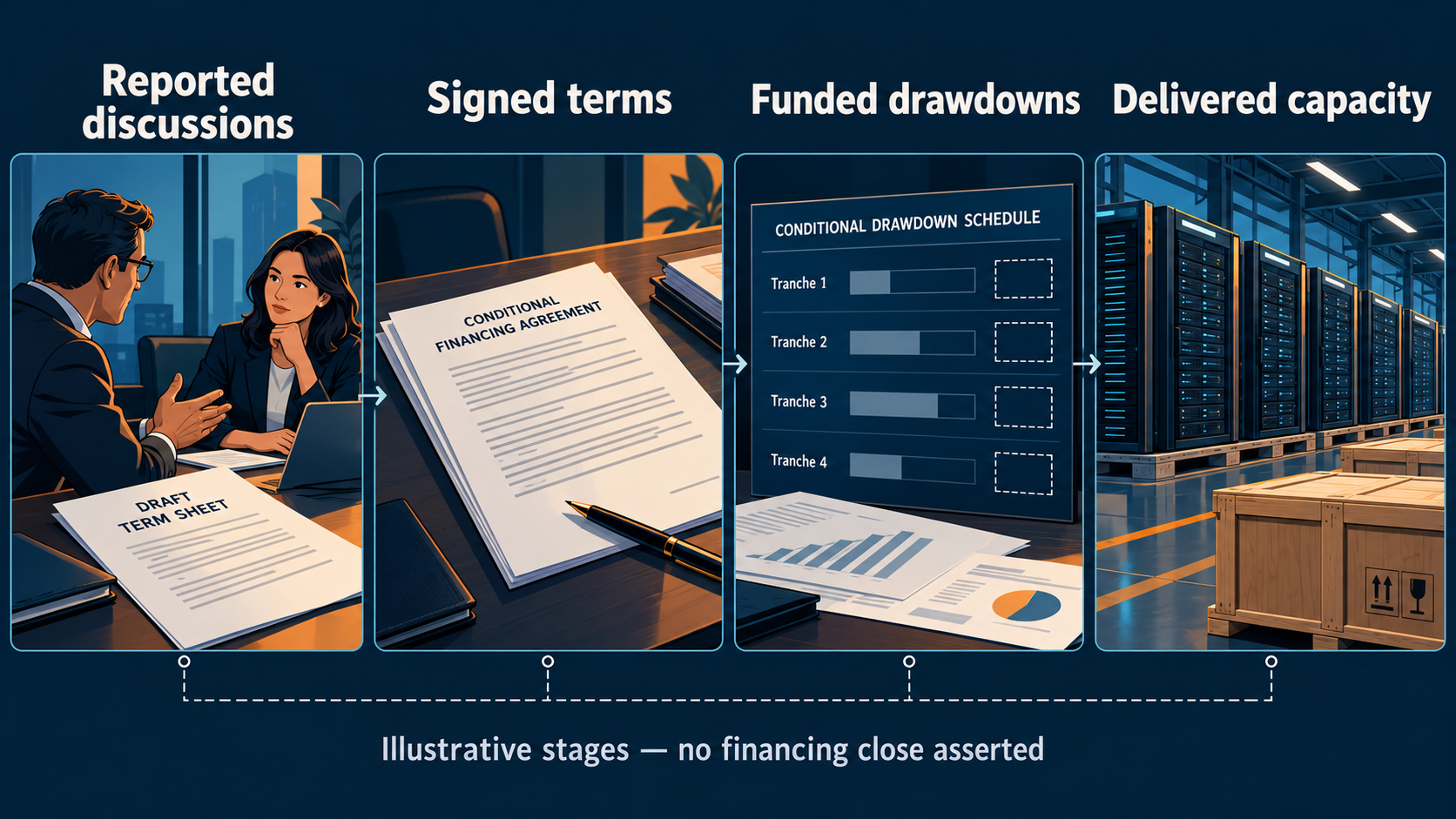
A hardware order and a funded project are different milestones
An announced expansion can contain several dependencies: purchasing equipment, preparing facilities, connecting power and securing customer demand. Financing adds another. A project may be technically feasible and commercially promising while still needing agreement on who supplies capital, when it is available and who absorbs a shortfall.
The financing structure matters as much as the headline amount. Corporate borrowing, equipment-backed lending and financing through a separate project entity can allocate risk differently. The reports reviewed here do not provide sufficient final terms to establish the structure, guarantees or security for the proposed arrangements. Assigning the entire reported amount to a particular company’s balance sheet would go beyond the available evidence.
For suppliers, this uncertainty can affect the interval between a commercial agreement and a firm delivery schedule. For customers, it can influence when capacity becomes available. The analytical implication is that funding milestones deserve a place alongside production and construction milestones when evaluating an AI expansion.
Debt forces a closer look at the timing of cash
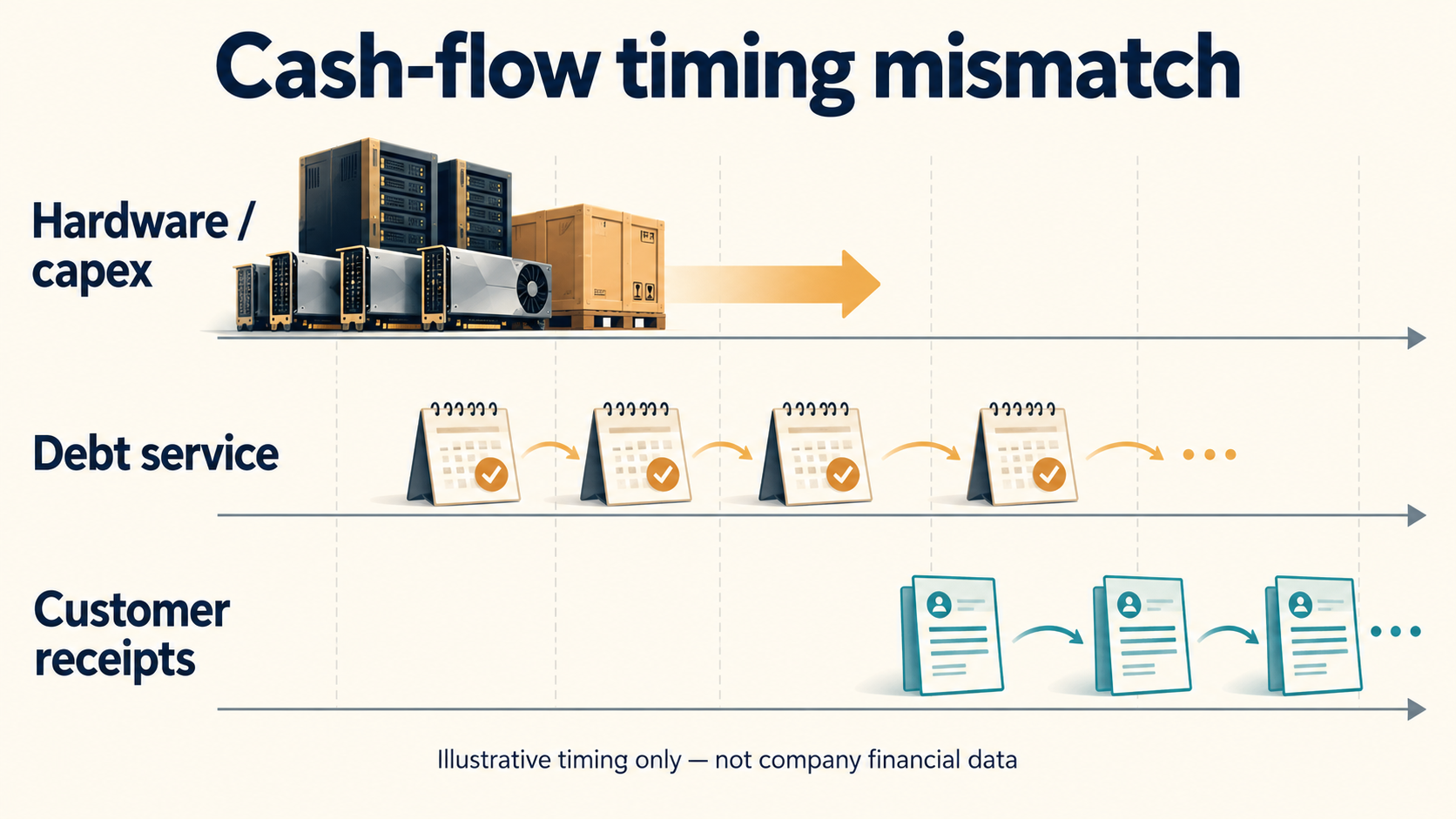
A computing asset can begin incurring costs before it earns meaningful revenue. Delayed commissioning, slow customer onboarding or low utilization can extend that gap. Debt generally adds contractual payment obligations, making the timing of cash generation consequential even when the long-term demand outlook appears attractive.
The sensitivity can be substantial at the scale being discussed. As a simple illustration, one percentage point of additional annual interest on US$50 billion of fully outstanding debt equals US$500 million per year, before fees or changes in principal. This is arithmetic, not an estimate of Broadcom’s financing cost: the actual borrower, debt amount, drawdown pattern and pricing remain unconfirmed.
Hardware also presents a useful-life question. A lender needs to consider whether equipment can continue earning enough as newer systems arrive. Physical operation, accounting depreciation and economic competitiveness are related but distinct. A functioning chip does not guarantee that the services it enables will retain their original pricing or utilization.
Customer contracts become part of the funding proposition
Committed customer demand can help a project obtain financing, particularly when payment timing and cancellation terms are clear. However, a large contract value alone says little about the cash available to service debt in a particular year.
A rigorous commercial review would examine minimum payments, delivery conditions, termination rights and customer concentration. It would also ask whether projected receipts depend on a small number of counterparties making their own ambitious growth plans work. These are questions for evaluating proposed structures, not claims that the reported deals contain particular weaknesses.
There is also a competitive implication. Providers with established cash flows and credible customers may be better positioned to negotiate financing through a difficult market. Smaller operators could need more equity, stronger customer commitments or a slower construction schedule. That remains an inference until actual financing terms and deployment decisions become visible.
The next evidence should be executable terms
FUVISIGHT’s view is that access to appropriately structured capital may become a more selective constraint on AI expansion. This does not require a market-wide funding shutdown. A higher cost of capital or tighter conditions could be enough to delay marginal projects while stronger ones proceed.
The view strengthens if financing closes with more demanding guarantees, larger equity contributions or terms that lead developers to revise deployment schedules. It weakens if borrowers consistently secure capital on manageable terms and operating receipts support the resulting obligations. The decisive evidence will be signed arrangements, funded drawdowns and delivered capacity, followed by cash generation. Reported fundraising ambitions establish the scale of the next test; they do not establish its outcome.